
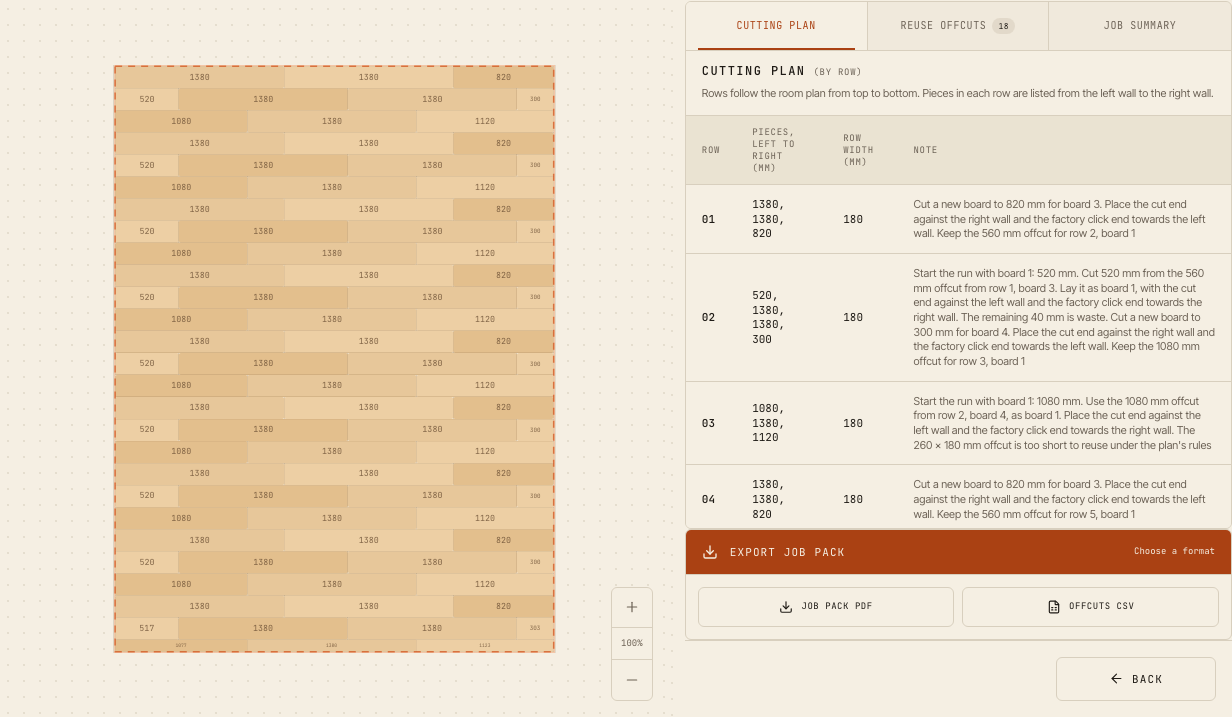
What is in the cutting plan?
Every row in the laying plan has its own row number. Under each row the boards are listed in the order they are laid, with their length in millimetres. Notes flag the starting offset and any short end pieces to check. Some people call it a cut list; it is the same row-by-row list.
Example: how to read one row of the cutting plan
In this simplified example the row is 3600 mm long after the expansion gap. The boards are 1500 mm long. That takes 2 full boards and one cut to 600 mm.
| Board | Length | What to do |
|---|---|---|
| 1 | 1500 | Lay a full board |
| 2 | 1500 | Lay a full board |
| 3 | 600 | Cut to 600 mm |
Keep the offcut until you have checked whether the plan uses it in a later row. The example only shows the board lengths in one row. Row widths, the saw kerf and the end-joint rules also belong in your own plan.
From room measurements to cut sizes
The planner first draws the floor area from your measurements. It then divides the area into rows by board width and laying direction, takes off the expansion gap, checks the joint rules and gives every board its cut size.
A cutting plan and a flooring calculator answer different questions
A flooring calculator, like the ones on retailer websites, estimates how many boxes to buy. A cutting plan shows which lengths and widths to cut while you work. You need both, and you should always check the cut sizes on site.
Offcuts carry over to the next row
When you cut a board, PlankBuddy checks whether the offcut can be used in a later row. It then shows where the offcut comes from and where to use it. A piece only counts as waste when the plan does not use it.
Take the cutting plan to the job as a PDF
When the plan is ready, you will find the cutting plan in the Laying step. Choose Job pack PDF to download the laying plan, the cutting plan and the offcut instructions in one document.
Always check the plan on site
Walls are rarely perfectly straight, and measurements can change along a wall. Check each row before you cut. The cutting plan is a working guide, not a replacement for measuring on site or for the manufacturer's installation instructions.
Want to understand the rules behind the result? Read about the expansion gap, end-joint stagger and row widths.