
Quick answer: floor area ÷ pack coverage
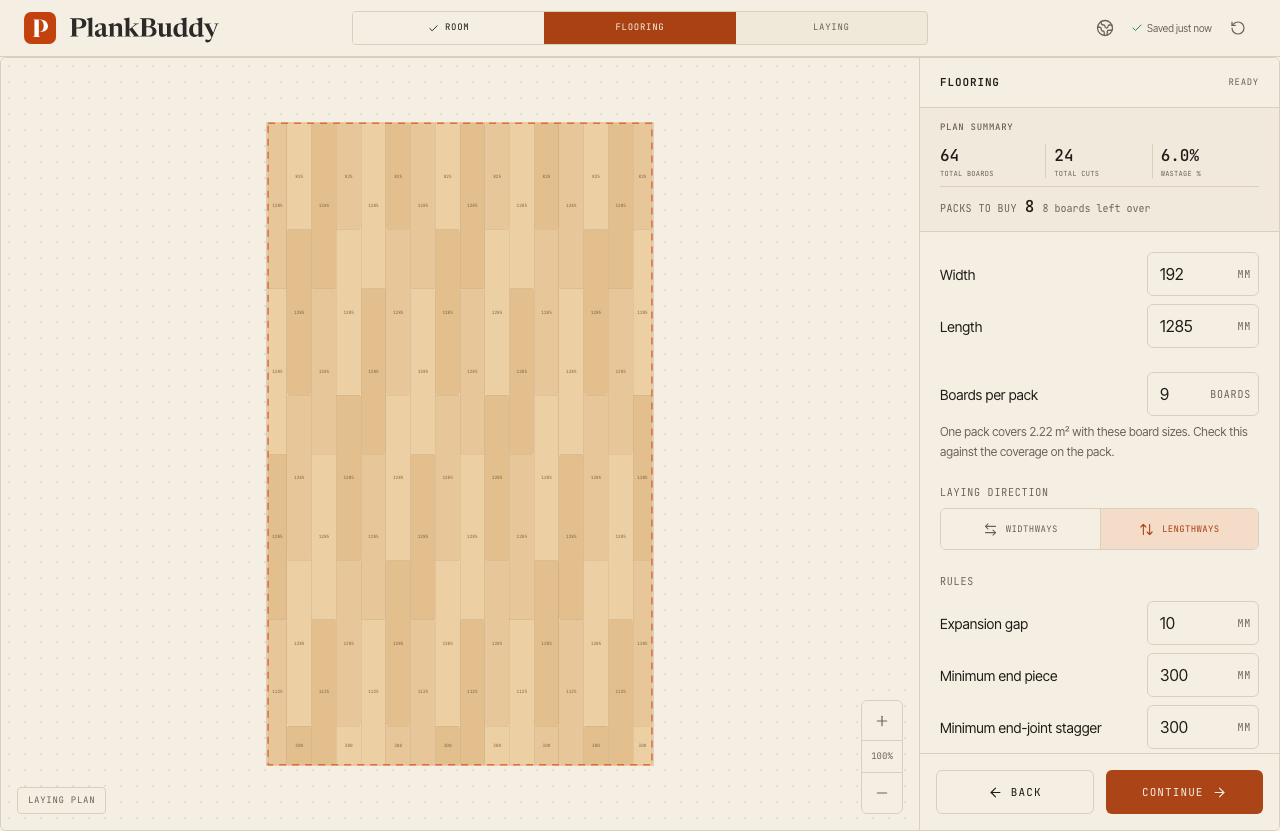
A 5.0 × 3.0 m room is 15 m². A pack with 9 boards of 1285 × 192 mm covers 2.22 m², so 15 ÷ 2.22 = 6.8, which rounds up to 7 packs. Add 10% for cuts and it is 8 packs. Retailer calculators (Wickes, for example) work out the area and leave the allowance to you; Wickes suggests adding 10–15% for cuts.
Why that is not always enough
The laying plan for the same room, with a 10 mm expansion gap and boards laid lengthways, uses 64 boards in 16 rows. 64 ÷ 9 rounds up to 8 packs, with 8 boards left over. Buy by area alone and the 7 packs hold 63 boards: 1 board short of the plan.
Read the coverage on the pack
| Board | Per pack | Coverage |
|---|---|---|
| 1285 × 192 × 7 mm | 10 boards | 2.47 m² |
| 1285 × 192 × 8 mm | 9 boards | 2.22 m² |
| 1285 × 192 × 10 mm | 7 boards | 1.73 m² |
| 1285 × 192 × 12 mm | 6 boards | 1.48 m² |
1285 × 192 mm is the common UK budget laminate board (Wickes and B&Q product pages, checked October 2026). The board is the same in every row; only the thickness, and so the number of boards in a pack, changes.
Why 12 mm packs cover less than 8 mm
Thicker boards come fewer to a pack. The same 1285 × 192 mm board comes 9 to a pack at 8 mm (2.22 m²) and 6 to a pack at 12 mm (1.48 m²). The room needs the same number of boards either way, but 1.5 times as many packs at 12 mm. Never work out the coverage from the board size: read it on the pack.
Packs for 10, 15 and 20 m² rooms
Each room below is a real plan from PlankBuddy with 1285 × 192 mm boards laid lengthways and a 10 mm expansion gap. The table compares three counts: by area alone, by area plus 10%, and from the boards in the plan.
| Room | Pack | Boards in the plan | Area only | Area + 10% | From the plan |
|---|---|---|---|---|---|
| 4.0 × 2.5 m (10 m²) | 8 mm: 9 boards, 2.22 m² | 43 | 5 | 5 | 5 (2 spare) |
| 4.0 × 2.5 m (10 m²) | 12 mm: 6 boards, 1.48 m² | 43 | 7 | 8 | 8 (5 spare) |
| 5.0 × 3.0 m (15 m²) | 8 mm: 9 boards, 2.22 m² | 64 | 7 | 8 | 8 (8 spare) |
| 5.0 × 3.0 m (15 m²) | 12 mm: 6 boards, 1.48 m² | 64 | 11 | 12 | 11 (2 spare) |
| 5.0 × 4.0 m (20 m²) | 8 mm: 9 boards, 2.22 m² | 84 | 10 | 10 | 10 (6 spare) |
| 5.0 × 4.0 m (20 m²) | 12 mm: 6 boards, 1.48 m² | 84 | 14 | 15 | 14 (0 spare) |
In 2 of these 6 cases the area-only count is short of the plan. In 2, the 10% allowance buys packs the plan does not need. The plan's measured wastage in these rooms is between 4.4% and 7.0%. Neither rule of thumb is right every time, because the count depends on how the rows fall in your room.
Area count vs layout count
An area count assumes every scrap of every board ends up on the floor. A laying plan knows where each cut falls: the end pieces in every row, the first and last rows cut to width, and which offcuts are long enough to start a later row. PlankBuddy reuses an offcut only when it meets your minimum end piece and stagger, and counts the rest as waste. The boards it uses, divided by the boards in a pack and rounded up, are the packs to buy.
How much spare to keep
- Buy all the packs from the same batch, so the colour matches.
- A board can be damaged or have a faulty joint. If the plan leaves no boards over, consider one more pack.
- Keep a few boards for future repairs; a range can be discontinued.
- Add the allowance your manufacturer or supplier recommends for your room.
Questions about how many packs to buy
How many packs of laminate flooring do I need for 20 m²?
With 1285 × 192 mm boards, 9 to a pack (2.22 m²), a 5.0 × 4.0 m room needs 84 boards in our plan: 10 packs. By area alone it is 10 packs, and 10 with 10% added. Your room, boards and pack size will differ, so plan your own room.
Should I add 10% to my flooring order?
Ten per cent is a common allowance for cuts, and awkward rooms may need more. A laying plan shows the boards your room really uses, so you can see whether 10% is too much or too little. Then add what your manufacturer or supplier recommends for damaged boards and spares.
Does PlankBuddy add an allowance to the pack count?
No. Enter the boards per pack printed on the pack, and PlankBuddy rounds the boards in your plan up to whole packs and shows how many boards are left over. Any extra is your decision.
Read how to work out flooring wastage from the plan, or how to avoid a narrow last row.