
How many boxes for a room: the usual calculation
A 12' × 15' room is 180 sq ft. A box of 8 planks, 7.1" × 47.6", covers 18.7 sq ft. Without a waste factor that is 9.6, so 10 boxes. With a 10% waste factor it is 198 sq ft, so 11 boxes. Take the sq ft per box from the box label rather than working it out from the plank size, because the number of planks per box depends on the product and its thickness.
Boxes for common room sizes
Counted by the planner with its default rules (a 3/8" gap, an 8" shortest end piece and stagger, 2" first and last rows) and the planks running along the room, then rounded up to whole boxes. The last column is the usual estimate: square footage plus a 10% waste factor, divided by the sq ft per box.
| Room | Plank and box | Planks in the plan | Boxes from the plan | With a 10% waste factor |
|---|---|---|---|---|
| 10' × 10' | 7.1" × 47.6", 8 per box (18.7 sq ft) | 43 | 6 | 6 |
| 10' × 10' | 8.7" × 47.6", 7 per box (20.06 sq ft) | 36 | 6 | 6 |
| 10' × 12' | 7.1" × 47.6", 8 per box (18.7 sq ft) | 53 | 7 | 8 |
| 10' × 12' | 8.7" × 47.6", 7 per box (20.06 sq ft) | 44 | 7 | 7 |
| 12' × 12' | 7.1" × 47.6", 8 per box (18.7 sq ft) | 66 | 9 | 9 |
| 12' × 12' | 8.7" × 47.6", 7 per box (20.06 sq ft) | 53 | 8 | 8 |
In most of these rooms the two counts agree; in the 10' × 12' room the plan saves a box with the narrower plank. A room with more corners and doorways can tip the other way. Your own room size, plank and direction decide, so check them in the planner.
Why a flat waste factor is not enough
Two rooms with the same square footage need a different number of cuts. The room size compared with the plank length and width, the direction, obstacles and the required end-joint stagger all change the result. An L-shaped room or a hallway with several doors needs more cuts than a square room. So square footage times a percentage can buy too much flooring for one room and too little for another.
Offcut or waste: what the plan counts
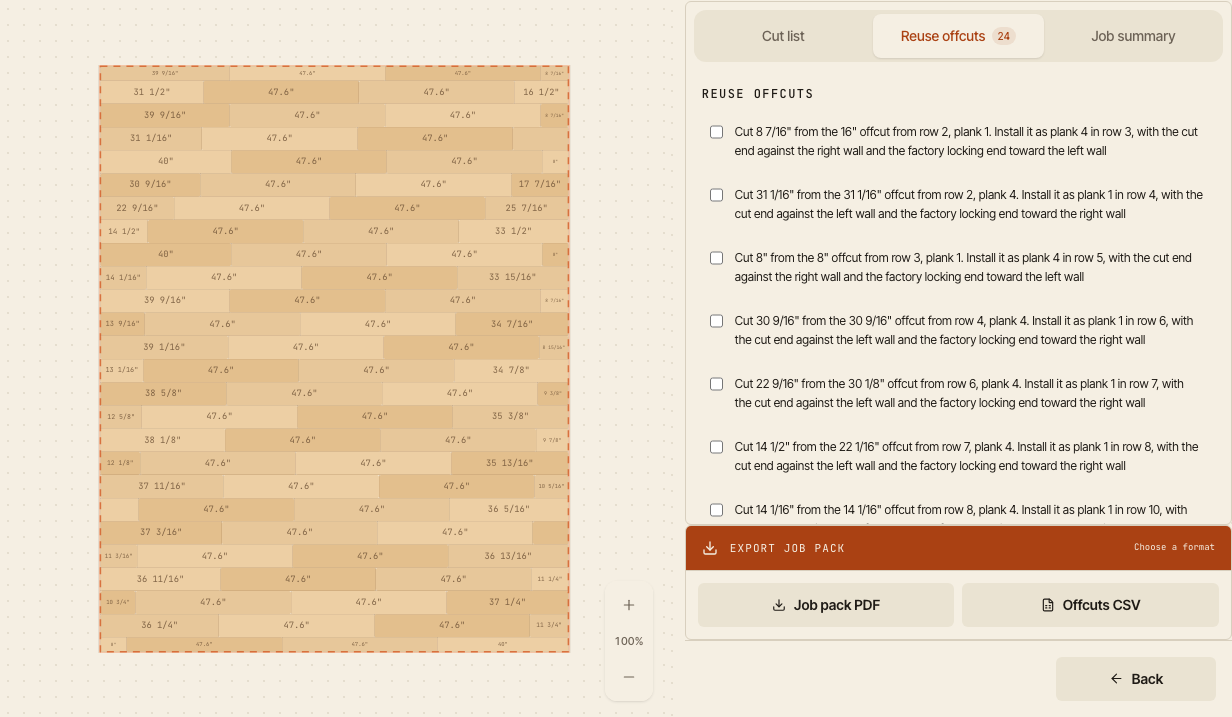
An offcut can become the first or last piece in a later row if its length and the end-joint stagger allow it. PlankBuddy shows where each offcut comes from and which row uses it. Only the offcuts the plan cannot use anywhere count as waste, and the waste percentage comes from them.
Boxes counted from the real planks
Enter the number of planks per box from the box label and the plan shows how many boxes to buy, for example 178.3 sq ft · 11 boxes · 18.7 sq ft per box. The count comes from the full planks the floor needs and the offcuts it reuses. It adds no waste factor: add the extra your flooring manufacturer or store recommends yourself. The sq ft per box is rounded down, as on the box, so the plan never claims more coverage than a box has.
How to keep waste down
- Compare both directions: see which direction to lay vinyl plank flooring.
- Plan the first and last row widths together.
- Start later rows with offcuts that meet your rules.
- Avoid pieces shorter than your instructions allow.
- Measure on site before every cut.
A waste factor is not the same as calculated waste
Do not order from the planner's waste percentage alone. Sorting planks for color, the odd damaged plank, future repairs and the manufacturer's recommendation all count. Where you can, buy all boxes from the same production lot so the color matches.
Common questions about how many boxes to buy
How much extra flooring should I buy?
Stores often suggest a waste factor of 5% to 10%, more for rooms with many corners and doorways. The plan counts the boxes from the planks it actually uses, with no extra added, so add the extra your manufacturer or store recommends yourself.
How do I work out the sq ft per box?
Take it from the box label. The plan shows it too once you enter the planks per box, rounded down to 0.1 sq ft so it never claims more coverage than the box has.
Is an offcut the same as waste?
No. An offcut that is long enough can start or end a later row. Only offcuts the plan cannot use anywhere count as waste.
Should I buy all boxes at once?
Yes, where you can. Planks from the same production lot match in color, and a few spare planks make future repairs easier.
Read also how end-joint stagger changes the cuts.